The Figurative Apex Predator

A while back I was introduced to Jimmy Carr. He’s a British comedian who I thought simply liked to tell dick jokes until I actually listened to him on and off the stage — he’s a master of the one liner and crowd work. He’s very funny, very smart and very thoughtful. I say this mostly for context but also as a reminder that shallow observations rarely offer any true understanding.

Jimmy Carr once offered an insight during an interview — he mentioned that if you drop a person in the Amazon jungle you are offering up lunch but if you drop 10 people into the same jungle, you have an apex predator. He went onto say that our strength as a species is in our ability to cooperate. This makes us strong, capable, inventive, and when needed, dangerous.

This got me thinking and solidified my belief that the best versions of people don’t come in the form of an individual but rather as part of a team. I struggle to think of a situation where an individual will best a group of people — formal cooperation makes it easier over a loose affiliation to be sure but since we are a social bunch, ultimately the individual never stands for long.

As I reflect on the best teams I’ve ever been associated with, I keep coming back to a few foundational considerations — build your teams with smart, curious and diverse people, outline objectives and expectations as guiding principles, create an environment that encourages respectful and candid communication and finally, offer space for the people to collaborate and be creative.

Is this easy, particularly when the team gets larger? No it is not. Although, if you’ve developed a good team around you, it happens all the time. The recent Artemis II launch comes to mind as we get ready to return to the moon.

Thank you team earth.

iamgpe
a Series of 10 — useful discomfort

By my count I am 4 blogs away from having written 500 blogs on my two websites. I thought it might be an interesting idea to write these remaining blogs based on the common threads that have woven themselves through the last 496 I have written — and with that said, “a Series of 10” will continue with a blog on the value of being uncomfortable.

Discomfort is one of my primary life tenets because it’s the primary driver for growth — we are hardwired for challenge and struggle and for all of us, there is no material growth without the discomfort that comes with struggle; be it intellectual, physical or emotional.

Don’t get me wrong, I enjoy being comfortable but I see it as a place to visit, not a place to live. I keep coming back to that famous quote by Nietzsche, “From the military school of life—what does not kill me makes me stronger” — symbolic as it is, it offers a reference for how to look at discomfort and what you can tolerate and by extension, the growth you can achieve. Don’t shy away from it.

I am not trying to convince you to carry my tenet but I will challenge you to look in the mirror and ask yourself to name a time you experienced material growth when it was easy. I suspect you will be hard pressed to find one.

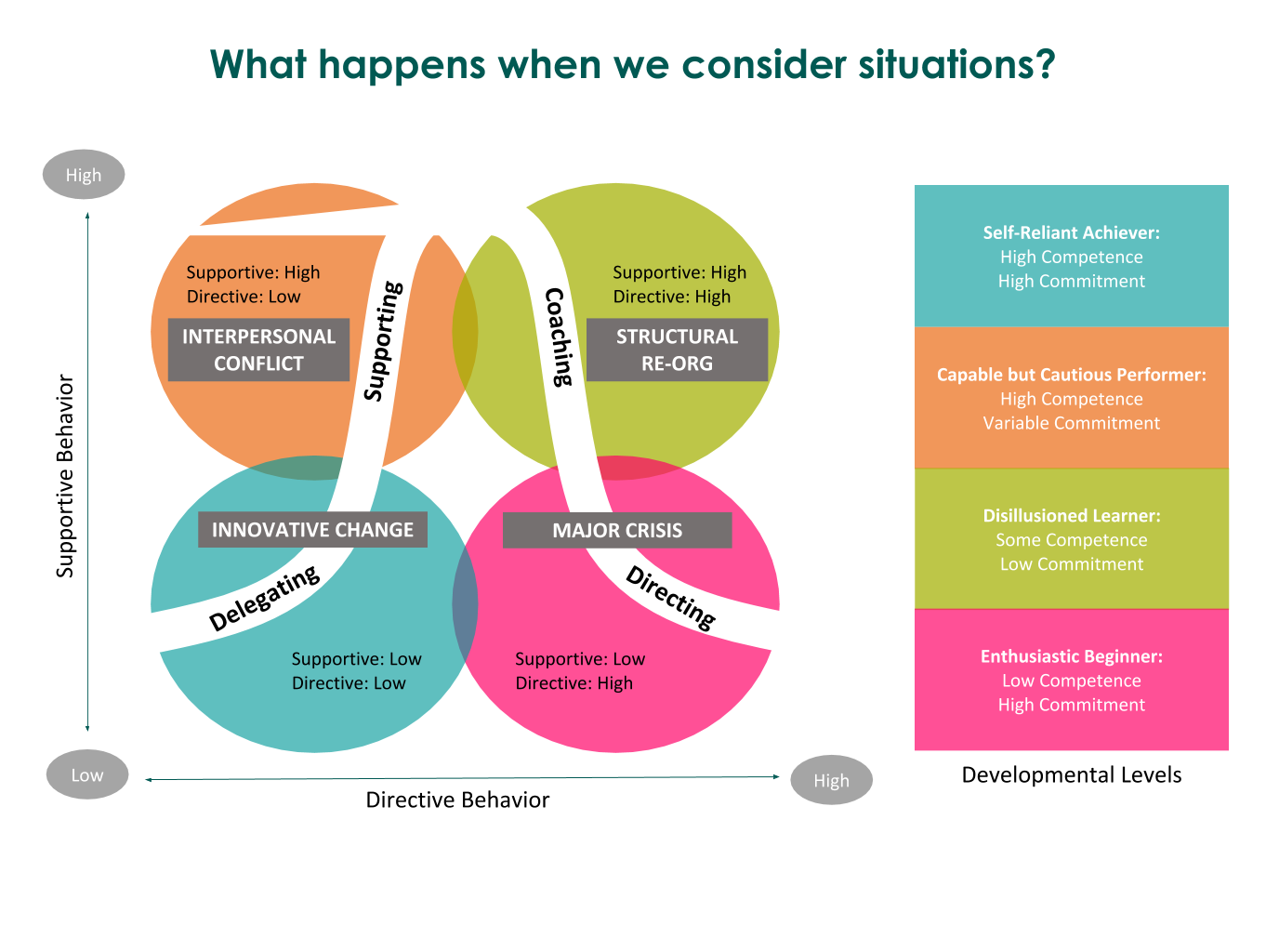
I would have stopped at this point because the importance of discomfort is a “full stop” in my mind — nothing more needs to be said. With that, I kept thinking about the Situational Leadership model developed by Dr Paul Hersey and Dr Ken Blanchard. It illustrates how discomfort comes into play if you are a leader of people, so I felt I should add a little more on the subject.

In their graphic representation of the model, you’ll see four quadrants representing a person’s skill sets and competencies — there is also a bell curve that moves through the quadrants that illustrates how each quadrant needs to be approached by a leader (see graphic). Anyone who is starting something new finds themselves in the lower left-hand quadrant. It is this quadrant that offers insight into discomfort.

You may not be so enthusiastic on my conviction about discomfort but it’s important to realize that those people in the lower quadrant, although enthusiastic, probably don’t know what they are doing, they’re frustrated with something new and uncomfortable with the struggle ahead. A leader needs to help people navigate through the discomfort (et al) to ensure success — and maybe on the way, recognize and lean into their own discomfort because leaders also need to grow.

At one time, I spent a fair bit of time with people new to the organization, and I was always quick to suggest they get comfortable with being uncomfortable. Those were the days when there was much growth for everyone involved.

It was so much fun.

iamgpe

3 more

a Series of 10 —Authority Without Noise

By my count I am 6 blogs away from having written 500 blogs on my two websites. I thought it might be an interesting idea to write these remaining blogs based on the common threads that have woven themselves through the last 494 I have written — and with that said, “a Series of 10” will continue with a blog on authority, and maybe even leadership.

I want to start with a layman’s definition of authority — it’s the recognized power or expertise to control and/or influence people. It is generally categorized as either Traditional Authority (custom, inheritance), Charismatic Authority (personal magnetism) or Legal-Rational Authority (law, bureaucracy).

Basically, authority comes with a title or personal magnetism and is validated with power or expertise. The clearest authority is when you are blessed with being a monarch or a VP of Operations because it’s on your business card (one of the reasons people get hung up on titles when they get a promotion). Charismatic authority is where most of us play because there are so few Lords and Ladies and even a VP of Operations gets fired occassionally.

Charismatic authority has muddied the waters with regards to what true authority or expertise is because there is a confusion that visibility, noise, showmanship and good production values are a proxy for authority (and particularly expertise) — if they look good, and they say all the right things, as well as being a little entertaining, they must know what they’re talking about. Right? Not at all.

There is a truism that says, and I am paraphrasing: validation of real authority is action and the success that comes from what you are doing — how does that old saying go again? “Less talking and more doing”. If you want to stretch your authority, take action that will move your objective forward. The more you are noticed for accomplishing successful things, the more you will be asked to do more. Ultimately your expertise and influence expands because of this.

Remember when you are striving for authority to raise your hand and volunteer, propose ideas to meet objectives, meet your deadlines, take on challenges with solutions not complaints, and network and build relationships to get things done — these are some of the good habits of authority.

Robin Sharma wrote a book called “The Leader Without a Title” which in this context is a nice reminder that you can have authority without officially having the authority. For me, quietly and with intention, driving action is a means to authority. Trust me, people will notice the quiet woman in the corner who is garnering everyone’s attention because she gets things done — particularly the attention of people who can help make things happen and champion the efforts.

And hey, if you want to be noisy about it, just make sure you are doing something other than making noise.

iamgpe

5 more